
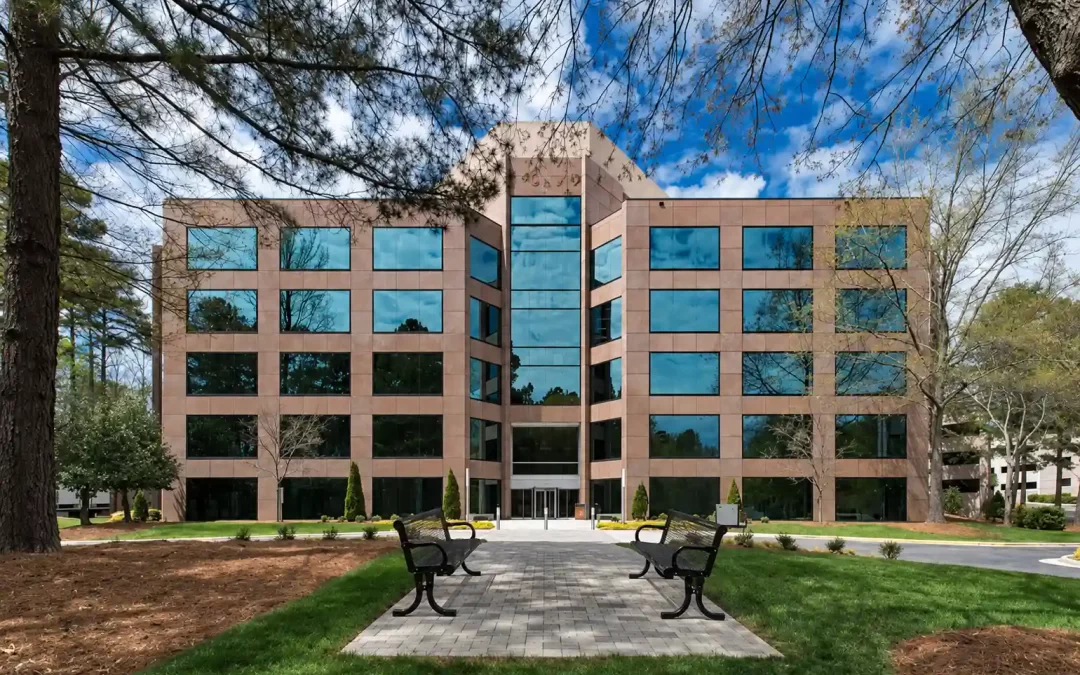
Raleigh just rezoned three Six Forks office buildings for 404 apartments. Easy to read that as another “office is dying” headline. It’s the opposite. The submarket is leasing better than almost anywhere in the Triangle, and a $16M office trade just closed up the road in the 5000 block. The three buildings at 5601 Six Forks are coming down because they’re 1980s product about to lose their anchor tenant — so the land became worth more than the building underneath it. That’s not an office collapse. It’s a land-value event wearing an office costume.
If you own older office product anywhere along a strong corridor in the Triangle, that May 19 council vote was an early warning, not a news item. The question isn’t whether office demand is finished. It isn’t. The question is whether your building is still the best use of your land — or whether your tenant roster is the only thing holding off the bulldozer. That’s a different math problem than the one most owners think they’re solving, and it has a clock on it.
Here’s the mechanism, said plainly. When a submarket gets hot enough on the residential side, two numbers cross: the per-acre residual value of your land under a residential or mixed-use entitlement, and the going-concern value of your building as leased. The moment the first number is bigger than the second — and the entitlement path is real — your building is no longer a building. It’s a holding cost on a piece of dirt. NGP didn’t pay the 5601 Six Forks number because they wanted office. They paid it because the dirt cleared 5 stories of NMX and 404 units.
Three signals tell you your building is now on this map. First: you’re 1980s or older product, two- or three-story, surface-parked, on a corridor where new residential is trading north of $200/sf. Second: your anchor tenant has a real move-out path in the next 24 to 36 months, even if they haven’t given notice yet — the way Public Health is leaving 5601 for the new DHHS HQ on Blue Ridge. Third: a council or planning commission in your jurisdiction has approved an upzoning within a mile of you in the last 18 months. If two of those three are true, you’re not running a building anymore. You’re running a covered land play, whether you meant to or not.
Three numbers to run before your next refinance or appraisal cycle. One: the residual land value at the highest realistic entitlement — five stories of NMX in the Six Forks case, more in the urban core, less in the suburbs. Two: the going-concern value of the building today, with your real rent roll, your real rollover schedule, and a real cap rate for 80s-era product — not the 7% you wish, the 8.5%–9.5% the market will actually give you. Three: the breakeven hold period — how many years of net operating income you’d need to clear what the dirt is worth empty. If that number is shorter than your remaining term on the anchor tenant, the answer is already there. You just haven’t said it out loud yet.
From there, you have three honest choices. Hold and execute through it: re-lease, ride the income, defend the building. That works if your corridor doesn’t move and your tenant base is stickier than the market thinks. Sell as-is to a covered-land buyer: take the land number now, exit the operating risk, redeploy the capital. That works if a credible developer is already circling and your debt clock is short. Reposition the asset yourself: entitle the site, take the development risk, capture the spread between the building number and the dirt number. Highest dollar, longest path, real risk, and the one most owners shouldn’t run alone.
If I owned 80s-era office on Six Forks, Wake Forest Road, or Falls of Neuse right now, here’s what I’d actually do. I’d run all three numbers this quarter — before the appraisal, before the refi, before the anchor tenant’s real intent shows up in a sublease listing. Then I’d pick a path and start the clock on it, instead of letting the council and the bank pick it for me. The owners who get hurt in this kind of moment aren’t the ones who chose wrong. They’re the ones who waited for someone else to choose for them.
This is your decision, not mine. But the Six Forks vote just put a comp on the wall for every older-product owner along a strong Triangle corridor, and the next appraisal cycle will use it whether you’re ready or not. If you own 1980s-era office on a corridor like Six Forks and you want to see what this table looks like with your address at the top of it, let’s book 30 minutes and walk the math with me on yours.
Source: Triangle Business Journal, May 29, 2026 weekly edition; cover article on 5601 Six Forks Road rezoning (Kayli Thompson, May 21, 2026).